Delta 9

I’m pleased to announce the launch of Delta 9 Systems,  www.delta9systems.coman industry leader and innovator in the areas of identification, labeling, data capture, and workflow efficiencies; helping cannabis companies improve productivity and enhance profitability.  As a division of our parent company, General Data, www.general-data.com, the Delta 9 team brings a deep understanding of the cannabis industry to work for today’s industry pros. Their cannabis experience goes back to the very beginnings of the Industry on the West Coast; including operating Collective Gardens, Recreational production and Retail operations. They speak the language, know the workflow and understand the challenges of the cannabis industry.


As discussed in the post about the merger of Color Label Solutions, General Data wanted our company given our position in the cannabis market: https://colorlabelsondemand.blogspot.com/2019/02/color-label-solutions-merger.html.   Delta 9 is a continuation of this effort to help growers and manufacturers integrate time and cost saving technologies required by today’s cannabis industry.  They help companies streamline work in process and finish good inventory, trace assets, and improve shipping and receiving operations.

Chris Guthrie, the General Manager of Delta 9, describes the current market as Cannabis 2.0.  According to Chris, “Cannabis 2.0 is about the data. The consistent production of great flower and oil is now the minimum requirement of a cannabis business. The numbers a garden produces and the way that data is collected, stored and acted on will determine the success of an operation. In a heavily regulated, highly competitive market like cannabis, operators will live and die by the data they can see and act upon.”  To learn more about Cannabis 2.0, read this post from Chris:  https://www.delta9systems.com/index.php?route=extension/d_blog_module/post&post_id=12


Chris Guthrie
 
When asked what solution is the most important for a cannabis operation, Chris replied, “I believe the Mobile Traceability Cart will help the majority of companies.  Currently, many cultivators have their traceability system set up in the office, far away from their growing operation.  With a mobile system, operators can move their traceability system to growth rooms, or to packaging; where ever it is needed. With the current state requirements, cultivators need to track and identify every in-process batch and all waste.  Our Mobile Traceability Cart solution makes this required tracking easy to do, and will improve the operation as well.”


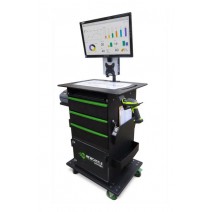
The Mobility Traceability Cart System include 5 components. First, the Newcastle QC510 Mobile Powered Workstation.


Cannabis Mobility Cart
Mobility Cart
With built in power source and strip, this cart saves labor, reduces errors and improves data collection.
In addition to the cart, the Mobility Traceability Cart includes an Elo TouchSystems ESY22i2 All In One Touch Screen Computer. 


Elo Touchscreen for Cannabis

The 22-inch I-Series for Windows is a multi-purpose fixed tablet, and delivers commercial-grade computing for the cannabis workflow. 
Also, the Mobility Traceability Cart includes a Datalogic Gryphon Scanner.


Datalogic Gryphon Scanner for Cannabis
Datalogic Gryphon Scanner
The Gryphon Scanner is designed to capture barcode data for in-process and finish good inventory as well as asset tracking.
The Traceability Cart also includes the Star Micronics Scale:


Star Micronics Scale for cannabis
Star Micronics Scale
perfect for the precision measurements of cannabis processing. 
And finally, the Citizen CL-E321 label printer to add barcodes to plants, waste and/or inventory.


Citizen CL-E321 Barcode Printer for cannabis
Citizen CL-E321 Barcode Printer
Discussing the Mobility Traceability Cart, Chris says “Traceability infrastructure is important with Cannabis 2.0.  Both Mom & Pop as well as Multi-State operations have the same requirements for track and trace.  And both type of operations will benefit from improvements derived from the information gleaned from this type of traceability system.”
Depending on your requirements, Chris and his team at Delta 9 Systems can built a system to meet your individual needs and budget.  Contact Delta 9 at delta9@general-data.comor call 877-303-8957.  If you prefer, contact us at Color Label Solutions.  We’ll work with the experts at Delta 9 to install the traceability system that meets your needs.

And if you work outside of the cannabis market, but still need traceability, contact us.  We’ll help with your trace and trace requirements. 
Guy Mikel
855-962-7670

Designing With White

Recently, I attended a presentation by Mike Corcoran on designing label artwork for the QL-300. As a Graphic Designer with years of experience and extensive knowledge in the packaging industry, Mike was able to provide valuable insight into the printing capabilities of the QL-300, the world’s first 5-color toner-based tabletop printer.   The QL-300 is a LED-based printer with the capability to add white to labels.  Additionally, the QL-300 enables the use of many new types of materials for print-on-demand color labels.

QL-300
QL-300

You may remember the first post on the QL-300:
https://colorlabelsondemand.blogspot.com/2019/02/ql-300-white-new-materials.html

After listening to Mike, I’m convinced the QL-300 offers ample opportunities for companies to create unique looks and effects with on-demand color label printing.  Let me give you an overview of why and how to use white and a wide variety of unique materials to create exciting, beautiful label designs.
First, why white?  According to Mike, “White can stand on its own, but can also lay behind colored elements to prevent them from blending into dark media or dark elements behind clear media.”
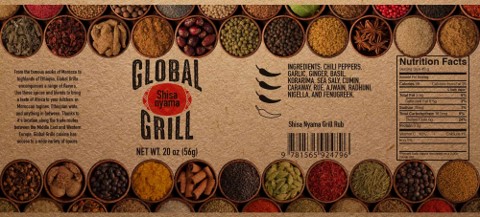
To illustrate this point, Mike created this example label artwork for Kraft paper.
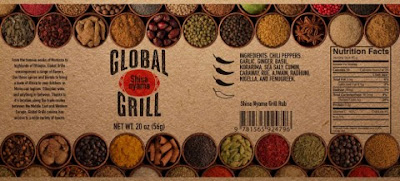

Kraft Label With No White

Notice two different aspects of the label print output.  First, the barcode would probably not scan with the Kraft background.  For all retail products, it’s imperative that the barcodes scan at checkout or retailers will issue a fine.  Also, notice how the nutritional facts are somewhat difficult to read with the Kraft background.
Second, notice how some of the colors of the various spices have blended into the background of Kraft paper.  When branding requires materials such as Kraft, you may want the color to “pop” more.
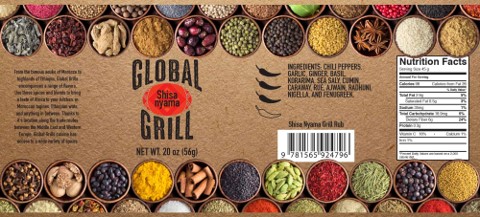
By adding white as a background, you can ensure barcodes scan well and text is easy to read.  Further, you can make the color stand out on dark backgrounds by adding white behind the colors.
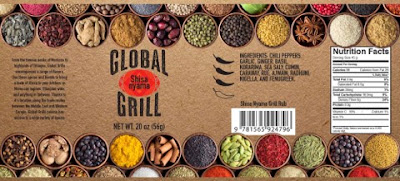
QL-300 Printed Kraft With White
This print output on Kraft paper looks noticeably better using the white background.
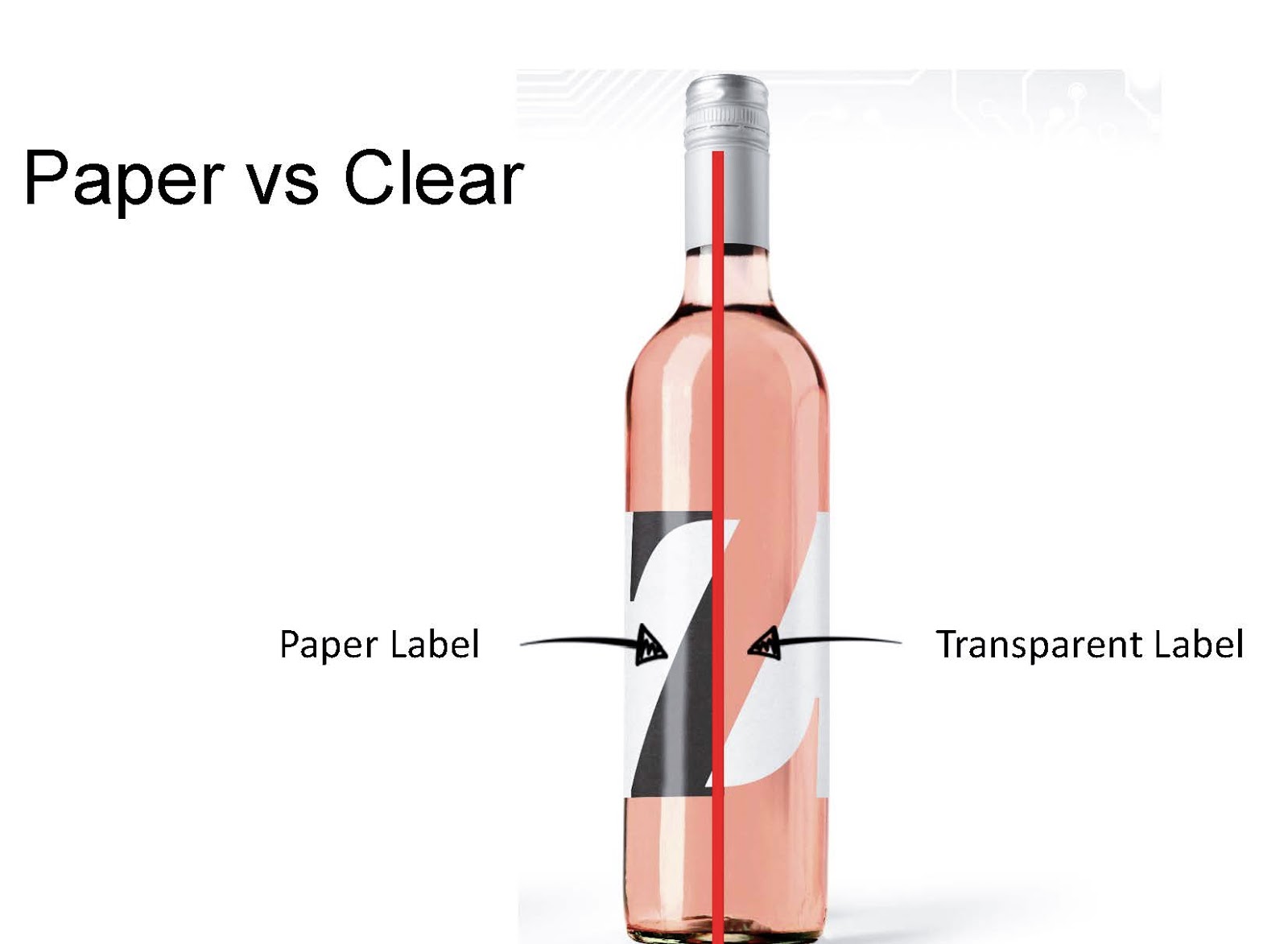
In addition to Kraft, white can a add pop on clear film as well as enable you to use the color elements of the actual product as a part of your artwork.  In this image, Mike shows how clear film uses the color of the product as a design element.
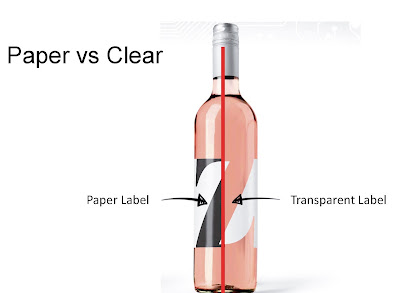
White Vs Clear (With White Printed) Label
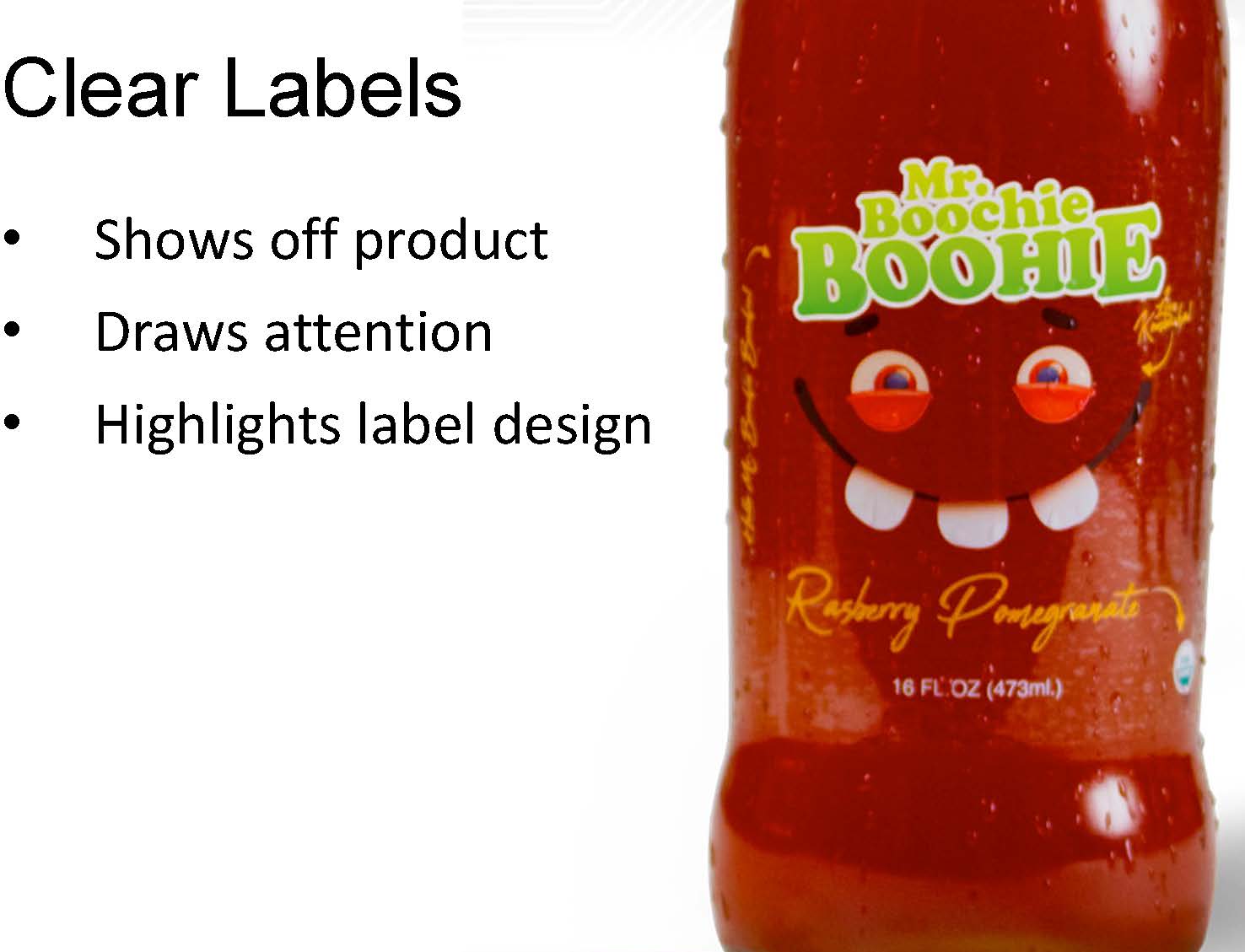
White On Clear Featuring The Product

In this design, Mike used the white to highlight the label design as well as the background to ensure the colors stand out.

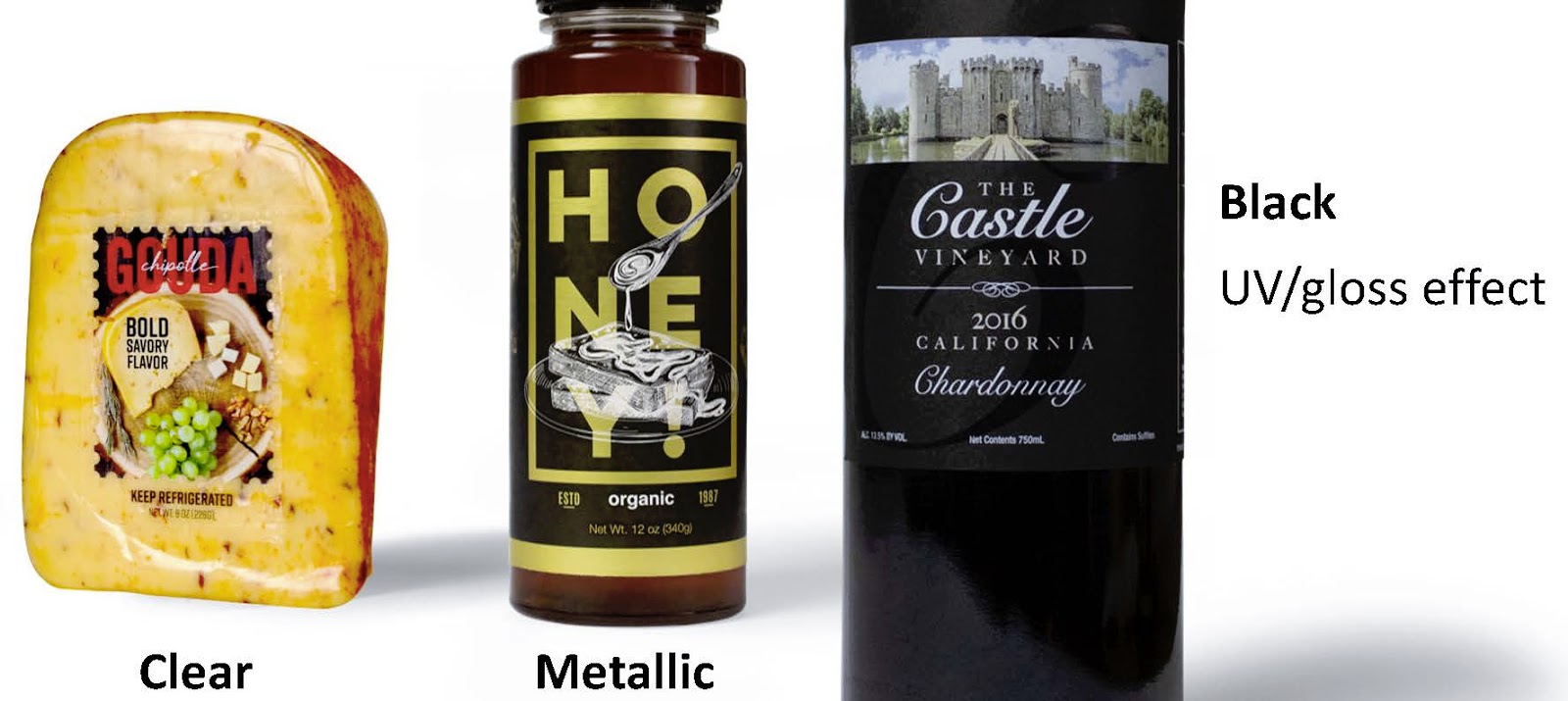
In addition to materials such as Kraft and clear film, the QL-300 enables other materials to create interesting effects.
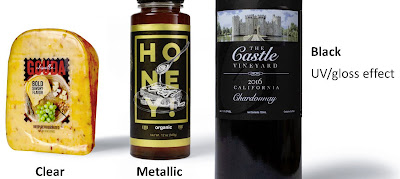

QL-300 Printed Materials

In this image, Mike shows how black toner on black paper creates almost a gloss or UV coating effect.  Black toner on a black label would seem to be an interesting effect; a designer’s dream!  However, you would not use white behind black ever.
To create stunning, beautiful artwork to take advance of the QL-300, Mike recommends Adobe Illustrator. (Please know: I’m not an A.I. expert). AI enables a graphic artist to design in images, add backgrounds and covert fonts to outlines.

Once the artwork has been created, Mike made one additional key point: save the files as a PDFX/x_1a:2001. PDF/X is a subset of the PDF ISO standard. The purpose of PDF/X is to facilitate graphics exchange, and therefore, has a series of printing related requirements which do not apply to standard PDF files. To learn more about this standard;
https://en.wikipedia.org/wiki/PDF/X

To learn more about design for the use of white and interesting label materials, check out this video from Mike:
https://www.youtube.com/watch?v=NpPqSYPkArA&feature=youtu.be

From my perspective, I see the QL-300 fitting three types of customers.  First, cannabis companies should consider the QL-300 where branding includes the use of foils, as well as many other design elements.  Second, food manufacturers, where clear film that enables the use of the product/product color as a part of the brand/label artwork.  Third, commercial printers who want to offer these capabilities to their customers.
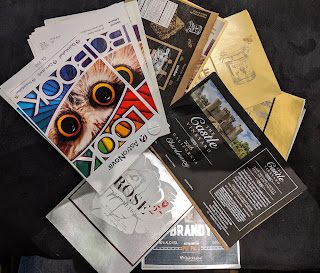

QL-300 Print Samples

For commercial printers, it’s worth noting that the QL-300 enables the use of ICC profiles and will soon offer a Postscript driver and RIP software (Raster Image Processor).  Many commercial printers may prefer this functionality as a part of their label printing workflow.
My thanks to Mike Corcoran for a great presentation and important education.  As Mike says, “the QL-300 is a game changer in print-on-demand color label printing.”  And our Graphic Artist, Tony Molina, says “having the white option gives label designers tremendous creative possibilities as well as flexibility when creating color labels.  The option to use white as a design element will make your artwork unique.”
If you want to create and print unique label artwork, contact us.  We’ll help you get starting printing with the new QL-300.
Guy Mikel
855-962-7670

Purchase the QL-300 here:

Labeling Machine Fault Finding

  A key strength to our labeling machine supply is how we go about fault finding. For LabelOn™ when there is a problem, we treat it as an opportunity ; an opportunity for us to shine and show our clients how we pull clear from any other labeling equipment solution that is on offer. “it’s […]

The post Labeling Machine Fault Finding appeared first on LabelOn™ US | Labeling Machines | Self Adhesive Labeling Systems.

LabelOn™ Mini Synergy – Accuracy of Application – Five Times Spot On

We’ve got you covered In the smallest of spaces! Two of the most difficult production line problems faced can be finding the room and finding the budget for equipment to accurately place labels onto your product. Check out our new LabelOn™ Mini Synergy Range: These are Power House pieces of labeling equipment that can sit […]

The post LabelOn™ Mini Synergy – Accuracy of Application – Five Times Spot On appeared first on LabelOn™ US | Labeling Machines | Self Adhesive Labeling Systems.

There’s Gold in Them Thar Hills – Or Should I Say Green

Medical Marijuana (MMJ) is a rapidly growing industry and continues to look like an attractive option and a smart move for manufacturers to service. In fact, medical marijuana alone is expected to be a $40 billion industry by 2025, and could grow to $100 billion by 2050 if all 50 states legalize. MMJ products have moved way beyond […]

The post There’s Gold in Them Thar Hills – Or Should I Say Green appeared first on LabelOn™ US | Labeling Machines | Self Adhesive Labeling Systems.

Plastic or Glass – What Difference Does It Make to Labeling

Comparing Plastic or Glass Containers 1. Product Handling With Glass you need to be more careful with product handling as glass breaks. Extra precautions include insuring there are no places where a build-up of product would result in an overflow of product that would fall off the machine.  Glass products can “catch” on one another and cause […]

The post Plastic or Glass – What Difference Does It Make to Labeling appeared first on LabelOn™ US | Labeling Machines | Self Adhesive Labeling Systems.

Is It Simply a Case of “How Much?” – Knowing What To Ask About Your Induction Sealing and Labeling Machinery

We get approached all the time with one simple question: “How much?” This is no doubt a critical aspect when deciding on a larger purchase. But few realize the complexity that goes into determining the right combination of equipment, process, and consumables for specific production requirements. If we state the price of machinery and/or consumables […]

The post Is It Simply a Case of “How Much?” – Knowing What To Ask About Your Induction Sealing and Labeling Machinery appeared first on LabelOn™ US | Labeling Machines | Self Adhesive Labeling Systems.

Improving Label Print Quality

Every week, we print samples and calculate estimated ink costs on label artwork from our new prospects and customers.  After printing all these samples, what is interesting is the print quality difference we see in the various artwork we received; especially with fonts.

PDF Poor Print Quality

Recently, we received a PDF that printed terribly (see above). While working with this document, we learned this artwork was created in Adobe InDesign. You could not read the text at all.  After seeing the horrible results, we attempted to decide what caused this poor print quality on this sample; and make recommendations to others based on our results.

Looking at the file, the first aspect we noticed was the file size; it was 70 KB.  Here is a brief summary of the different aspects of file sizes:
https://en.wikipedia.org/wiki/File_size

To store one letter in a file, it takes 8 bytes.  One kilobyte holds 1,204 bytes or 128 letters.  70 KB should store only 8,960 letters.  Therefore, this file was compressed dramatically when saved as a PDF.  Compressed files and/or files with limited data just don’t print well.  The expression “GIGO: garbage in, garbage out” describes what happens when attempting to print a file with limited data. 
But file size doesn’t describe what happens with every piece of artwork that doesn’t print well.  According to Tony Molina, Graphic Artist and Digital Marketing Manager for Color Label Solutions, “text files don’t require a large file size to print well. I’ve printed label samples with only a few hundred KB’s, and they print great.”

The second aspect of this file was font size.  To determine the font size, I copied the print output from the PDF into BarTender; and found the font size as 3.5 and 4 pt.


4 PT Font Using BarTender
To help you understand the size of these fonts, I used the Font Converter website: https://www.thecalculatorsite.com/conversions/length/points-to-inches.php

To convert “pts” to inches.  A 4 pt font is 0.055”; 55/1000th of an inch.  A 3.5 pt font is 0.048”; or 48/1000th of an inch.  That’s small.  In this article, the author recommends no smaller than 5 pt font for a viewing distance of 2 feet:  http://resources.printhandbook.com/pages/viewing-distance-font-size.php

In this article, the author recommends no smaller than 7 pt fonts for hazardous labels: https://app.croneri.co.uk/feature-articles/minimum-font-sizes-labels.   Therefore, 3 and 4 pt fonts make labels difficult to read.

Third, font type makes a difference as well.  When I copied the text into BarTender, I noticed immediately that the text was readable even at the small font size.  I realized that the default font type was Ariel:  https://en.wikipedia.org/wiki/Arial.  


Given the result, Tony copied the text and reproduced the same label in QuarkXpress.  Using the same font used in Adobe InDesign, he got the same results from the pdf produced in QuarkXpress.  The pdf file from Quark still printed terribly.   By changing fonts, Tony saw much better print quality.


According to Tony, “Font types make a big difference in terms of print quality.  Some fonts are thinner, so they don’t print as well especially when small.  Choosing a font with balanced kerning and tracking (letter-spacing) is also important.  When the distance between two letters are set too closely together, words can become indecipherable; set too far apart, and they’re awkward to read.  I suggest choosing a clean, solid, dark-colored, sans serif font when using small text in a design. The smaller the text, the darker the color should be.”
Continuing, Tony says, “Most fonts are designed to produce good quality, but some may not.  In this case, I used a Helvetica font and it printed great.”
From this exercise, we relearned 3 key aspects for text print quality:
  • Select fonts carefully to insure good print quality.  Just because the font looks good on screen, doesn’t mean the fonts will print well.
  • Use fonts of sufficient size so they can be read easily.
  • Save files with as many bytes as possible; the more the better when it comes to good print quality.  Do not use compressed file types for printing.


For a more complete recap for designing labels that are easy to read, review this post with 17 tips on printing fonts: https://www.companyfolders.com/blog/17-essential-tips-printing-fonts
Some of these tips don’t apply to print on-demand color; rather for professional printers.  But several of the tips work completely when designing label artwork to print on-demand and in color.
If you need assistance in designing artwork for your labels, contact us.  We’ll insure your labels print GREAT!
Guy Mikel
855-962-7670

Amazon Transparency

As a Prime member and a very tiny shareholder, I’m a big fan of Amazon’s business.  But have you heard of Amazon’s project to prevent counterfeit goods?  It’s called Transparency
https://brandservices.amazon.com/transparency

and a perfect requirement for on-demand color labels.  Let me tell you more:

Amazon Transparency
Amazon Transparency

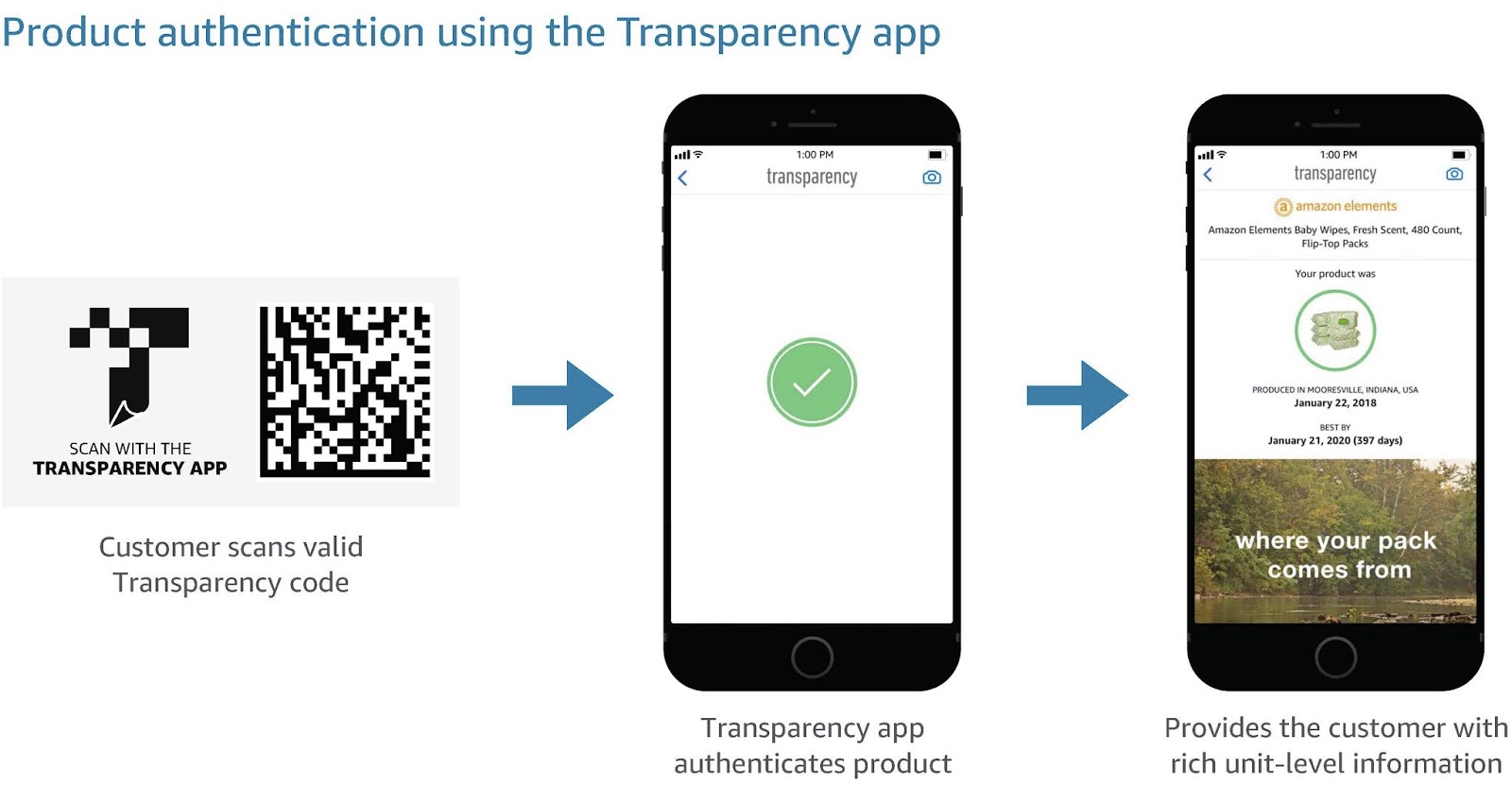
Transparency is an industrywide, retailer agnostic service that proactively detects the sale and shipment of counterfeit goods, tracks chain of custody, and improves transparency of products at the consumer
level.
To participate, a company (Brand Owner) needs to meet the following criteria:
  1. Sells on Amazon US
  2. Has a valid US Trademark
  3. Owns an approved US trademark in the Amazon Brand Registry system
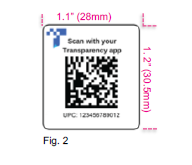
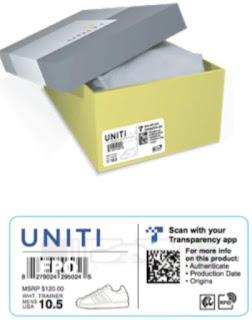
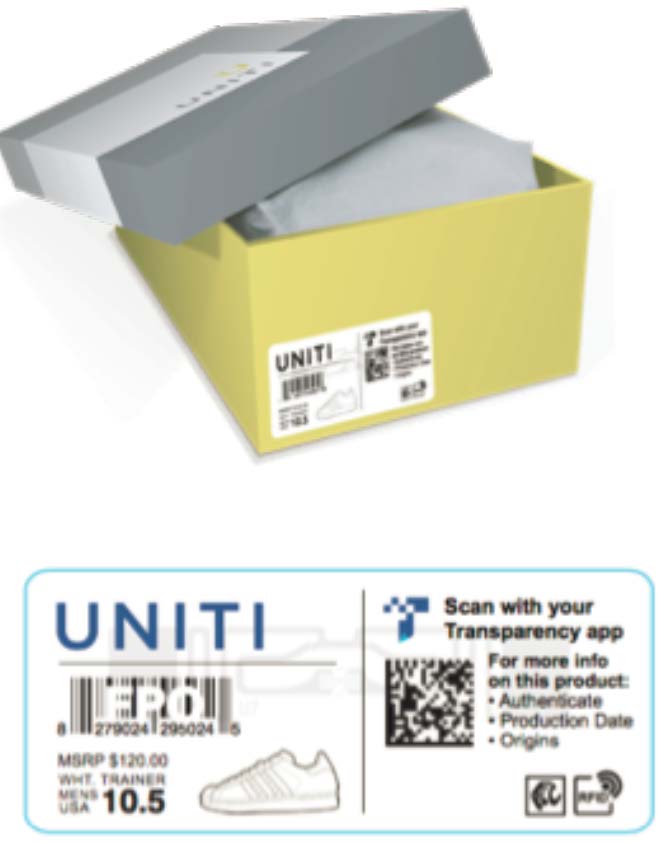
Once approved, brand owners must add a unique item code entered into a Data Matrix 2D barcode on every package along with the Transparency Logo.

Amazon Transparency
Amazon Transparency
Once a brand owner has enrolled and gained approval along with adding the Transparency code/logo, Amazon scans every package to insure authentic products are shipped.  Then, end user customers can use the Amazon Shopping App to authenticate the products purchased. In addition to the data matrix 2D code and logo discussed earlier, Amazon wants brand owners to add a call to action such as the following: “Scan with your Transparency app to learn about this product’s life cycle.”

Amazon Transparency
Amazon Transparency
I first heard of Transparency from Misty Catlin, in Sales with General Data.  Misty says, “I first heard about Transparency from a customer who needed support to deploy this application in their plant.  Since this initial customer, I’ve now had 2 additional companies contact me about this project.  We at General Data are positioned perfectly to help companies meet the requirements of Transparency with our expertise in barcode systems and label manufacturing.”

Amazon Transparency
Amazon Transparency
From my perspective the need for a color logo along with a variable data barcode makes Transparency a perfect requirement for an on-demand color label solution.  Combining the serialize and encoded data from Amazon, label creation and printing software and a color label printer, companies can meet the requirements of Amazon’s Transparency project affordably.  And you can add this workflow prior to shipping to Amazon or their customers, making the solution quick and easy to implement.
Our Transparency contact at Amazon states the proactive counterfeit program delivers exclusive benefits to both the brand owners and end users:
  1. Product quality reviews have improved
  2. Concerns about unauthorized sellers have diminished
  3. Trust builds with customers; with instant access to origin of manufacturing and validation of authenticity


Amazon Transparency
Amazon Transparency


To learn more about Amazon’s Transparency, read this detailed article: https://digiday.com/marketing/amazon-grows-transparency-program-fight-counterfeits/

 If you want or need to implement Transparency, contact Misty (talktous@general-data.com or 844-643-1129) or I.  We’ll help you deploy a solution for printing the logo, Data Matrix 2D code and Call to Action on demand and in color.
Guy Mikel
855-962-7670

Auxiliary Labels On-Demand

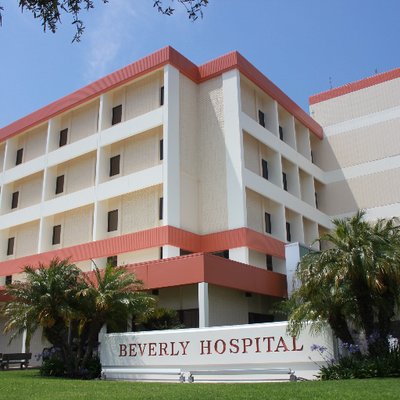
Since 1949, Beverly Hospital, https://www.beverly.org/,  has maintained a tradition for providing high quality care to local residents of Montebello, Pico Rivera, Monterey Park, El Monte, Whittier, East Los Angeles and surrounding communities.


Beverly Hospital is a not-for-profit, leading and independent 224-bed acute care facility that is proud of the medical services and comfort provided to patients. From emergency room and hospitalization to outpatient procedures, Beverly Hospital offers a full range of services with the latest technology; including the pharmacy.
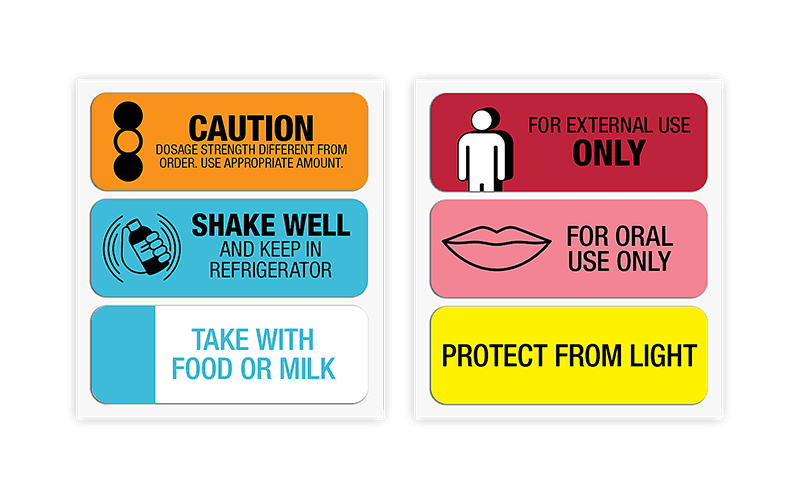
Beverly Hospital, like other small to midsize hospitals in the United States, processes about 2000 prescription orders per day.  About 250 of those orders or prescriptions require instructional color labels such as “Look-alike Sound Alike”, “For Oral Use Only”, “Protect From Light”, and “Shake Well and Keep In Refrigerator”.  Wayne Campbell, Director of Pharmacy of Beverly Hospital says, “we get these auxiliary labels from 4 different label manufacturers. Sometimes we’d get them in a timely fashion; sometimes we don’t.  We don’t know who ordered what from whom or when it’s coming in.  It’s very challenging”.


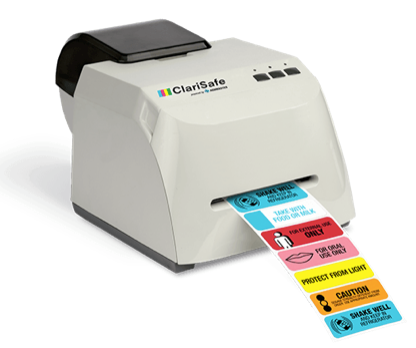
To improve this situation, Beverly Hospital deployed the ClariSafe Color Label Solution from Addmaster, https://www.addmaster.com/product/clarisafe/with partners HP, and Neenah Paper.   Addmaster has over 30 years of experience developing and manufacturing inkjet printers for the financial market with over 300,000 printers installed worldwide. John Clary, VP of Engineering at Addmaster, decided to develop an inkjet color printer with a small footprint and software that mimics pharmacy personnel ordering from a catalog to print the color labels they need when they need them. 

ClariSafe Printer
ClariSafe Printer
“ClariSafe™ can print all of my labels on-demand, any time I need them.  It prevents overstocking.  It prevents us from running out of labels and enables us to make special labels that are not available on the market” says Wayne. 
ClariSafe Label Catalog
 Learn more about the ClariSafe deployment at Beverly Hospital here:


According to Alex Shafer, Director of Business Development for Addmaster, “The ClariSafe Color Label System costs $1,495 and includes both the printer and application to print durable color labels when needed.  Plus we’ve added and will continue to add labels in the catalog as hospitals want and need more secondary artwork to print.”
As you may remember, I’ve written about ClariSafe before:  https://colorlabelsondemand.blogspot.com/2016/11/new-option-for-pharmacyanesthesia-labels.html

To purchase the ClariSafe Color Label Systems, visit our store: 

To purchase ClariSafe ink, visit out store:

https://colorlabelsolutions.com/product/clarisafe-tri-color-inkjet-cartridge-97262/


For pharmacy managers, ClariSafe is a great option to simplify secondary/auxiliary labeling. This system eliminates purchasing a large inventory of labels, enabling you to print what you need, when you need them; with a very small footprint device.  Contact us if the ClariSafe Color Label Systems may fit your pharmacy operation.
Guy Mikel
949-680-7840

info@colorlabelsolution.com 

Coatings

After the acquisition of Color Label Solutions by General Data Corporation (GDC):


I had the opportunity to visit one of the key drivers of our interest in joining GDC:  The coating division.


GDC Coating Operation
Let me tell you more about our interest in this group; and more about the group’s capability.
Before I start describing the coatings group, I want to give you a simple primer on how labels are made.  General Data has an entire webpage/video to answer this question.


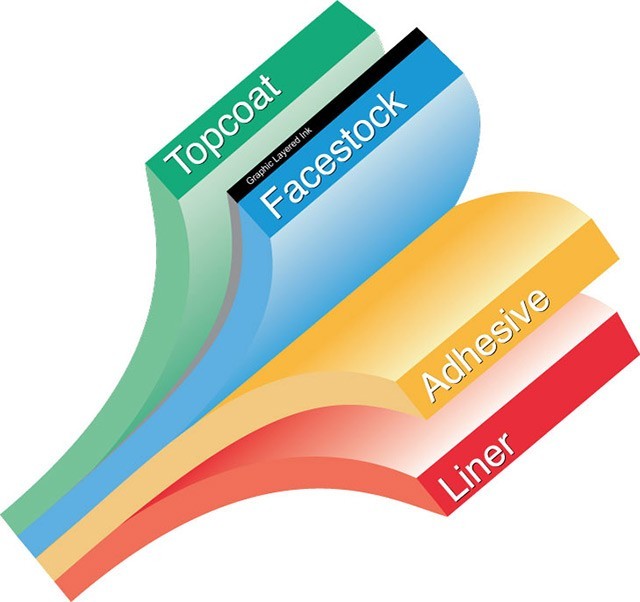
Labels have 4 primarily components:
  • Topcoat
  • Facestock
  • Adhesive
  • Liner (which is technically not a part of the label but a necessary carrier)

Label Construction
Label Construction


The Facestock is the paper/synthetic material that makes up the most visible part of the label.  Underneath the facestock, a layer of adhesive is coated to adhere the face to whatever is to be labeled.  The liner, underneath the adhesive, is a carrier to make it easy to expose the adhesive.  On top of many or most facestocks, is a topcoat designed to adhere the ink to the face.  Currently, I would estimate the 95%+ of the labels we sell have an inkjet topcoat.
To make labels involves a seemingly complex supply chain involving 3 key participants:

  • Raw Material Providers
  • Coaters
  • Converters

Label Supply Chain
Label Supply Chain
Raw material providers sell paper, synthetic paper, liner and adhesives to coaters.  Coaters create constructions of a variety of types of label materials.  Converters die cut the labels into specific sizes; as well as many produce preprinted labels.
Given the importance of coatings, the ability to coat is an important value creating function in the label supply chain.  Long term, this function should make GDC very competitive in the on-demand color label market.

General Data’s coated products division is an industry leading contract coater, specializing in the development and production of engineered films and other materials. They utilize an array of face materials, adhesives, substrates, coatings and topcoats to meet the specifications of our customers for a wide variety of applications.

John Finger, General Data Corporation

According to John Finger, Vice President of Research & Development for the Coatings Division of GDC, “we started coating about 4 year ago.  We saw the need in the market to custom coat materials for specific applications.” 
During our discussions, I asked John “what is your largest type of coating that you currently apply.  John stated, “about 2 years ago, we started coating adhesives; specifically, new technology around UV adhesives.  We had a customer/partner who asked for our assistance to produce this new product.  Now we coat not only these specialty adhesives but also adhesives for the products we sell.  We not only purchased previous coated material from some of the largest, industrial coaters, but also coat label adhesives for our own internal use.”

GDC Coater
GDC Coater

Once I understood about the importance of coating adhesives in the GDC operation, I asked, “what other materials do you coat?”  According to John, “one interesting film we coat and sell is a 7 Mil adhesive applied to a building material.  In addition, we coat pressure sensitive enclosures for food; resealable bag closures.  Also, GDC coats products that are for laser, thermal, digital, scratch resistant and dry erase applications.  After 4 years, GDC is selling many different coated products.”

After working in the business for many years, I see the capability to coat an important aspect in the label market.  Again, the large industrial coaters will continue to supply the majority of the market.  But specialty items such as inkjet coatings, produced in relatively small quantities, will become a more important aspect of the label business.  This capability should insure the long-term viability of Color Label Solutions, Inc.

Contact us if you have interest in a specialty label product.
Guy Mikel
855-962-7670

Color Label Solutions Merger

I’m pleased to announce that Color Label Solutions has joined General Data, https://www.general-data.com/,  as an independent operating unit focused on print on-demand color labels.


General Data is recognized as an expert resource for all aspects of labeling, automatic identification, barcode data collection, field mobility, equipment service, fixed asset management, and managed print services. General Data’s “total solutions” approach enables customers to utilize their expertise in all areas – planning, equipment specification, label media, printer consumable, system integration, customization and professional services.
When asked why General Data decided to purchase Color Label Solutions, Pete Wenzel, President and CEO, said, “General Data purchased Color Label Solutions for two primary reasons.  First, Color Label Solutions has become a preferred provider of label printing solutions to the cannabis market.  The importance of branding combined with the requirement for variable data make this market perfect for print on-demand color labels. General Data sees Color Label Solutions as a vehicle to sell a wide range of products to this market; specifically, barcode/RFID printers, scanners, WiFi systems, POS solutions, on-site service, and preprinted labels.”

Pete Wenzel, President/CEO, General Data
Continuing, Pete said, “Second, General Data decided to pursue harder the on-demand color label and flexible packaging market; both on-demand and preprinted.  Merging with Color Label Solutions gives us more knowledge and market access to grow this business.”
Color Label Solutions, www.colorlabel.solutions,  will continue to operate independently as a stand-alone business unit with employees in several states and customers across North America. 


Since day 1, we knew our company would need to integrate vertically to remain competitively in the label market.  For example, thermal transfer label prices have decreased significantly since this technology was launched in the 80’s.  To prepare for this potential price competition, we required a means to produce inkjet and laser labels and tags as affordably as possible.  General Data not only converts labels but also has the capability to custom coat materials, with both adhesives and top coatings.  By joining General Data, Color Label Solutions will remain competitive in the color label market long term.
Color Label Solutions launched in July of 2013.  Read our first post after formation here:

And our first video describing our company and mission now over 5 years old:


Color Label Solutions was started to help customers move to print on-demand color label printing. We saw the opportunity in the market for a different way to print labels in color; with the change in color label printer technology, the need for GHS labels in the chemical industry and the interest of manufacturers to print full-color labels when needed.  After 5.5 years, we now have over 240 posts, covering all aspects of printing labels on-demand and in color.  And don’t forget the 98 video’s on our YouTube channel:   


Or why manufacturers should move to on-demand color and our company:

Beatriz Molina, Co-Owner and Vice President of Operations says, “We’re looking forward to the potential synergy from merging with a larger organization with outstanding manufacturing and service capabilities.  Not having this expertise internally, Color Label Solutions will be able to do more for our customers with the merger.  For all of us employees, supporting and helping our customers is our primary goal.”  Meet the Color Label Solutions team here: https://colorlabelsolutions.com/our-team/

For most customers, only the “remit to” address should change.  With the merger, Color Label Solutions will be able to offer a much broader line of products and services to customers further growing our company. All stakeholders in Color Label Solutions will benefit with the purchase by General Data.  And most importantly; the General Data team are good guys!
If you have questions on the purchase of Color Label Solutions, feel free to contact me/us.  We look forward to our exciting, mutually beneficial, future.
Guy Mikel
855-962-7670

Making Re-Purposed Glass Packaging Possible with Induction Sealing and SealerOn™

Induction Sealing Glass The appeal to pack into glass is well documented. Those seeking products in glass are looking for product that is not tainted by plastic contact.  They are looking for purity in the product and most likely align themselves with the goals of environmental awareness and sustainability. If packaging can be recycled, that […]

Making Re-Purposed Glass Packaging Possible with Induction Sealing and SealerOn™

Induction Sealing Glass The appeal to pack into glass is well documented. Those seeking products in glass are looking for product that is not tainted by plastic contact.  They are looking for purity in the product and most likely align themselves with the goals of environmental awareness and sustainability. If packaging can be recycled, that […]

Making Re-Purposed Glass Packaging Possible with Induction Sealing and SealerOn™

Induction Sealing Glass The appeal to pack into glass is well documented. Those seeking products in glass are looking for product that is not tainted by plastic contact.  They are looking for purity in the product and most likely align themselves with the goals of environmental awareness and sustainability. If packaging can be recycled, that […]

Induction Material Liner

Material Liner is what we call that piece (or pieces) of what looks like paper inside product caps. It is also referred to as induction foil, induction sealing material, foil seals and induction seals among others. Many people are unaware of the purpose they serve to the product aside from being a protection seal or […]

MeRo Induction Sealing Machines

We believe there is no better value medium priced “High End” Induction Sealing Equipment. There are unique features to allow process validation and adjustable width sealing head tunnels are available. MeRo Induction Systems feature: An Air cooled system (Absolutely no need to water cool the induction head). Compact construction for easy integration into the filling […]