LabelOn™ Mini Series

LabelOn™ is introducing the newest addition to its line of labeling machines, the LabelOn™ Mini Series.

LabelOn™ Mini are Tabletop Labeling Machines with smaller footprints designed for smaller businesses or start up companies who understand the struggle of placing labels to their products by hand. They can be widely used in different size bottles designed for smaller production run.

The LabelOn™ Mini Tabletop Label Applicators do everything their more expensive counterpart machines do, but with the fraction of the cost. The demand for these smaller labeler machines is undeniable. Highly accurate, they will apply your labels quickly and efficiently which saves you valuable time and make a huge statement in the appearance of your finished product.

The LabelOn™ Modular Labeling Machines

Label Applicators

The LabelOn™ Modular represents a machine concept born from extensive labeling experience.This experience involved design, sales, and overseas distributor establishment.  Distributors in over a dozen developed and emerging economies enjoyed remote servicing, sales support and frequent visits.

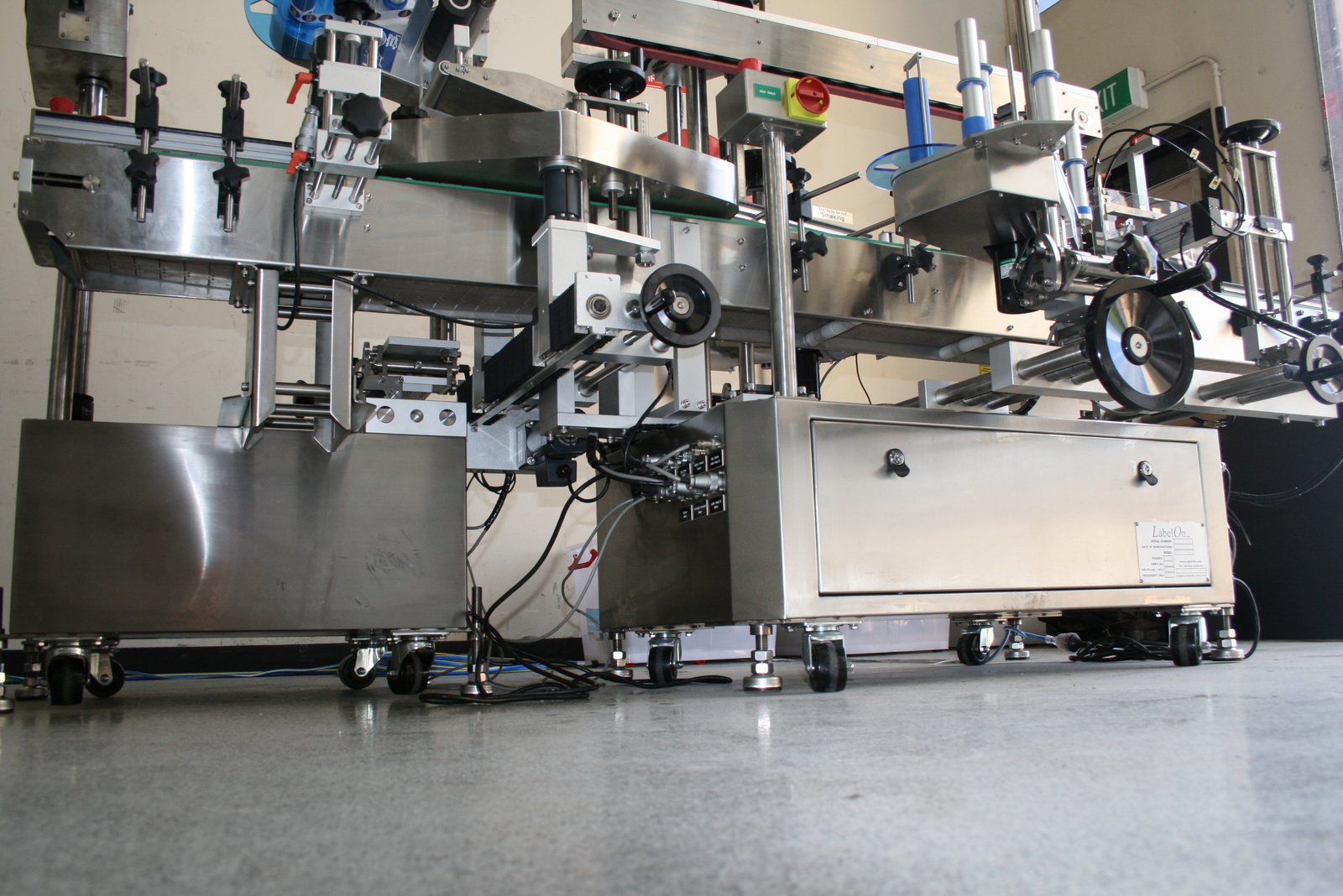
LabelOn Modular Labeling Machine 1What you are seeing is the result of that experience – the LabelOn Modular label applicator. It is a labeler that can be sold and represented throughout the world.  This machine is manufactured and configured in modules to cover a vast majority of the most common labeling tasks.

This LabelOn Modular machine has modules available to label front and back labeling of Flat Sided Bottles ,   Oval Sided Bottles and Round Bottles or Jars.

The Round products can have a single label of up to 100% Wrap label. The Round bottles can also have their label or labels placed; orientated to a reference feature or mark like a bottle handle or a pre-existing label.

Extra Labeling System

Adding to this impressive configuration of modules is the Extra Labeling System or E.L.S. – seen here ready to label LabelOn Modular Labeling Machinethe top of a product as it passes through the LabelOn Modular machine. On its own the ELS  is an impressive piece of labeling equipment, capable of placing spot labels from Above, the Side or On to angled panels like necks of bottles.  The ELS can be wheeled up to existing conveyor lines to work in a Stand-Alone Capacity.  However, the real ingenuity of the ELS is its design to “dock” with the LabelOn modular machine and synchronize to the modules of the main machine.  Even its controls are passed over to the Main LabelOn modular unit.

Clients, like contractors with multiple lines, will appreciate having one or two ELS systems that can dock in minutes to one of their more numerous LabelOn Modular machines for when promotional spot labels are required; say on the neck of the bottle or even its cap.

For a given labeling task the required modules integrate smoothly and present a machine that has the adjustments and feel of a machine that was dedicated to that task. Adjustments are easy to make and self-evident in most cases. These adjustments are easy to record and replicate for future runs.

Labeling Machine Support System

Extensive 3D mechanical records, and comprehensive electrical records of each machine enable over the phone and internet based sessions to quickly identify service items or parts.  To date, we have not come across a service requirement where a LabelOn technician had to attend on site; it was all handled remotely.

The LabelOn Modular Machine offers:

  • Unprecedented versatility and upgrade paths
  • Technology utilised to the fullest for machine service and support
  • Intuitive and predictable machine adjustments and
  • Amazing value for this level of labeling equipment

Used Labelling Machine Buying Guide

Label On Labelling Machine

Having decided it is definitely time to automate your label application, the next step is finding a labeller that you can afford.
Labelling a flat or oval sided bottle you can be faced with new machine proposals that range from USD 30K to USD 120K. Labelling a round bottle can involve new machine proposals of USD 13K to USD 100K. These price tags can be scary and fall into a range that you simply cannot afford.

A potentially very low cost source for second hand and used labelling equipment are auctions for packaging equipment. A simply internet search will bring up many auction houses and listings. There are also places that buy up lots of surplus or liquidated packaging lines and then offer the line components separately.

Labelling Machine

Ideally you will have well qualified electrical and electronic staff and a good mechanical workshop to support the used labelling machinery. The model machine you find should be a machine that spare parts can be purchased from the manufacturer or the representative to that manufacturer. A good preliminary step would be to do research on the cost and availability of spare parts for that model from that manufacturer. A word of warning here, some used equipment may be past the service life of the machine and hence spare parts may no longer be available.

When reviewing the used label applicator you locate there may not be the luxury of seeing the machine operate or having a guarantee the machine will work for your application. Therefore, look for machinery that, when advertised, is advertised as “versatile”. If you are not sure about what a versatile labelling machine means take a good look around the LabelOn™ Modular Label Applicators.

The machinery should have facilities for very easy and quick adjustments to cater for product a wide range of product widths and heights. The label Heads should have tilt controls in two directions. Tilt adjustments should be available along the direction of the product conveyor and towards the product conveyor. Given there is double axis tilt control there is a very good chance the machine can be configured to the shape of your product, from the shape of the products for which the used equipment was originally produced and supplied. The electronics should be Modular and ideally plug in and plug out electronics. The electronics should use standard components. Steer very clear of used label applicators that have proprietary electronics and touch controls as these will usually be very expensive to replace and very difficult to repair without paying top dollar from the machine supplier.
Wherever possible get as much information from the original machine supplier to determine the capability and serviceability of the used label applicator. There are bargains to be found and there are cheap used labelling machines to be found, on some rare occasions it can turn out to be that $50 lying on the side of the road that nobody else noticed. In most cases used labeling machines will represent a compromise on what you need as compared to what is available.

Sanstrap Stretchbands for Fruits and Vegetable Growers

Sanstrap is a clever pallet strap with substantial flexible strength produced from eco friendly PE film. Simple application delivers superb pallet load stability within minimum time. Perfect to secure pallet loads of: cartons, drums, pails and rolls.

The introduction of this elastic stretchband in the past can be regarded as a form of emerging trend inside the product packaging market. By simply placing an elastic stretchband on the upper layer of a pallet, a high system stability is the outcome. Because of its straightforward application (rather than the use of adhesive tape, for instance) and without harming the product packaging – it is especially recommended for intra-company transportation.

Fruits and Vegetables

In the successful marketing of perishable goods like fruits and vegetables, fast transportation and distribution with minimum damage during shipment is very essential.  Crates and boxes are often used for storage and movement of goods.  Prior to the movement of goods, the pallets need to be secured to prevent high stacked pallets from falling or shifting during movement. Different methods can be applied:

  • Stretch wrap or adhesive tape both take time to apply and time to remove. Adhesive tape can damage the boxes and it is an unpleasant product to work with, noisy, sticky and sometimes sharp.  Stretch Wrap is time consuming and to apply it takes far longer and may require dedicated packing stations and equipment.
  • Sanstrap product is a pleasure to use and easy to apply. It is also very easy to remove. And it is a plastic that can be recycled.

Handling and Stowage Practices of Fruits and Vegetables Growers

While the shape and condition of trucks or vans are essential elements in fresh produce transportation, the actual loading and stowing techniques are relevant to damage and loss:

  • the best loading factor should be attained, which is the maximum load that could be transported economically under satisfactory technical conditions;
  • the dimensions and design of packages must provide sufficient degrees of venting of contents with the least wasted room, and the packages needs to be sufficiently strong to safeguard the contents;
  • loading and unloading need to be correctly monitored to avoid reckless handling of packages; loading aids like trolleys, roller conveyors, pallet or forklift trucks has to be employed where possible in order to lessen the handling of individual packages; the use of Sanstrap palletbands can be employed when loading and unloading stacks.
  • stowage has to be cautiously carried out to prevent collapse of the stow for the duration of transport; Sanstrap stretchbands provide easy access to the cargo.
  • packages must not be piled greater than maximum recommended by the producer, otherwise the lower tiers may possibly collapse under the weight.
  • packed produce has to be shielded from the weather all the time including in the course of loading and unloading;
  • If the load will be dispersed to a number of destinations, packages has to be loaded backwards to which they will likely be unloaded, i.e. last on, first off; concurrently, the load has to be distributed equally around the vehicle.


When is the Best Time to Buy a Self Adhesive Labelling System?

A number of business owners or flourishing companies are turning up on the retail and wholesale market having a good potential product that will land them a good market share and even create a brand new market. Many are broadening their selection or growing their output capacity.

Each one is confronted with the very same concern; when is it time or when is it warranted to invest funds on a label applicator. Let’s study the 4 probable payback areas for automating your label application in an effort to respond to this inquiry.

1.0    Production Throughput

An in-line pressure sensitive label applicator will typically pick up labelling speeds from under 15 pieces each minute to approximately around eighty goods per minute for many applications as compared to manual or semi-automatic labelling. Labelling may typically be automated at between thirty five and forty five pieces per minute for many round products that call for orientation. This will enable swift turnaround of medium and big orders, eliminating bottle neck in your premises.

2.0    Product Presentation – Consistent, Accurate Label Placement

When presenting your merchandise to the market, eliminating the common mistakes of labelling such as label creasing and also irregular label setting will make a big impact. First impressions count and if you have a new product completely ready for the market you must be conscious about how soon an initial impression is created by people based on the first couple of seconds of simply looking at the presentation. Start up companies can achieve automated labelling results by means of an automatic labelling system through contract manufacturers or hiring systems.

3.0    Automating your production – A Good First Step

Often, the first piece of in-line equipment invested in by a company to manufacture in house is the labeller. Modular systems with the flexibility to deal with numerous range of shapes without any or marginal change parts are the most effective systems. In-Line Labelling machines will normally have a conveyor of length 3.0 meters or less and can feed on to gathering tables or close to the end of a selection and packaging table where by operators remove, check out and package the finished goods.

4.0    Production Cost Savings – Installations can have payback periods of 6 months or less

One area of underestimating expenses for those starting out in business is the time and cost of manually putting on labels. Aside from the “costs” related to the first three considerations in the above list you can find considerable labour expenses to be saved. To be able to manually label a container or product in the western world, the real cost is anywhere between 3 cents to 20 cents per container. Pace in manual labelling can rarely be held; a speed of more than 15 labels per minute eventually ends up to six labels per minute – 1 in every ten seconds. In Asia, where manufacturing cost is lesser, this might work out to be 2 cents or less per label. In higher cost manufacturing bases like Australia, Europe, the USA or South Africa this labelling cost is more likely to rise towards 5 cents per label for every product. Do remember some products have 2 labels or even three labels.

Justifying the acquisition of a labelling system varies; several businesses can benefit in every 4 areas at once while some may benefit on just one of the above criteria. When taking into account a labelling system you should contemplate all four major reasons in the above list and how they might apply to your circumstances.

Whether or not to move to a more in depth machine proposal and eventually proceed through formal machine proposal, machine suppliers providing the Label-On™ modular system of labelling can quickly assist you.